Showing posts with label Yalicreatives. Show all posts

Monday, August 15, 2016

The Imperialism of Feminism

In the Western history, women were expected to stay at home, where they were taught how to be good wives and good mothers, and of course how to stay pretty and silent. They felt dominated and oppressed economically, politically, and in their own bodies. They decided to speak up and fight for equality.


They got released from home and went to school. They now occupy positions their grandmothers and mothers never dared dream about. They boast economic independence, now able to afford everything a consumer society creates to anticipate their wildest desires. They contribute to the full functioning of the capitalist machine, just like the other half of humanity, with the exception of certain wives of well-to-do men.

They are involved in political activities – some of them even leading countries – and one is about to lead the most powerful country if she manages not to get knocked out by the glass ceiling.

They claim to be in control of their own bodies, while the pharmaceutical industry feeds them hormones that convert male fish into female, and the beauty industry (mainly controlled by men) defines how their bodies should look with the goal of selling more yogurt and cars.

They are still expected to be good wives, mothers, and of course, pretty. They also have to be as competent as men at work, while making less money. The pressure to perform well, both at home and at work, is silently crushing them while their unrestrained pursuit of the perfect body leaves deep wounds but no visible scars.

And now they want to free all the ‘oppressed women’ around the world. As always, they have started by setting up universal rights for complex and plural women.


In African history, women’s conditions have always been diverse, depending on their background as rural or urban women, whether their society is patriarchal or matriarchal, the ethnic group they belong to, the country or region they are from, and their personalities. Consequently, their need for equality differs dramatically depending on their social class, cultural background, beliefs, values, and the way they were socialized to be women in non-individualistic societies. They too used to be discriminated against because of their gender, notably in terms of access to lands and high-income activities. They too used to deal with arranged marriage, polygamy, female genital mutilation, rape, and domestic violence. Within the same Africa, women never stopped being the drivers of economic activities (in agriculture and trading). They never stopped influencing policy or familial decisions through their men (husbands and sons), who personify authority within their social group. They never stopped exercising spiritual power as priestesses. They never stopped organizing and fighting for their rights.

Being freed from the domination and oppression perpetrated by the other half of humanity is the least of their concerns. Revolutions and evolutions have to be driven by and within the oppressed people themselves. The contingencies of a given society impose changes naturally, but when the changes are dictated from the outside, it is called imperialism.
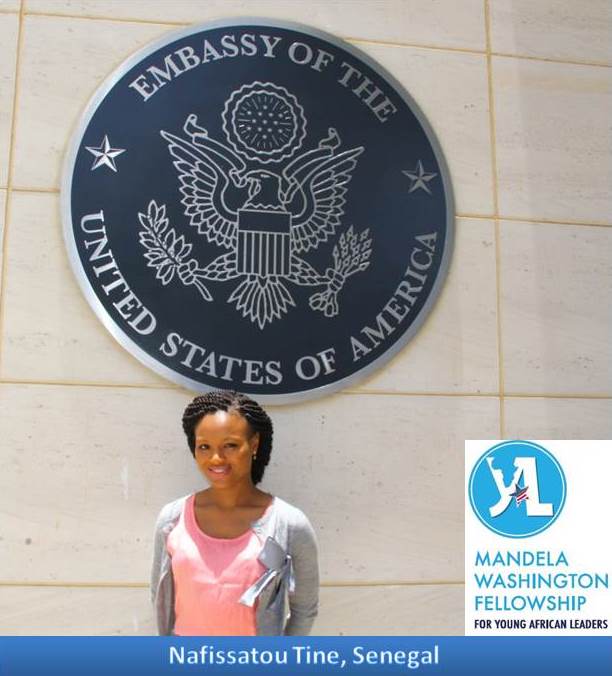


Mandela Washignton Fellow 2016
nafi.tine@yahoo.fr


Read More »

Friday, August 5, 2016

The Senegalese Mandela Washington Fellows were received on Tuesday, August 2, by his Excellency Ambassador Babacar Diagne, representing President Macky Sall in Washington DC. As usual, the Senegalese young leaders were driven by their commitment to involve Senegalese authorities in all their endeavors. As they met President Sall in Dakar, in June, before leaving for the Mandela Fellowship in the United States, the Fellows found it relevant to visit the Embassy and Senior Senegalese officials in DC, showing once again their foresightedness and their respect to the Institutions of their beloved countries they are all committed to work for.


Excellency Diagne praised the visit as one of the most relevant initiative. He congratulated each one of the fellows and inquired on their various profiles. At the onset of his speech Ambassador Diagne appreciated how young leaders, throughout all the country, are striving to push our nation forward. “ We were here when Réné Dumont wrote l’Afrique noire est mal partie. We were here also when Axelle Cabou published “ Et si l’Afrique Noire refusait le développement. Today, you are showing that change is possible. You are writing a new narrative. We are proud to have you to carry on the flag” said the Ambassador. He also shared his vision of Africa and Senegal in the coming years.

The discussion was very casual and Ambassador Diagne, commented on various topic raised by the fellows: his years at Radio Televison Sénégalaise, his stay in the Gambia as ambassador and his present work in DC. For him, it is always a privilege to serve our nation in the world first power, the United States. He reviewed the different lines of the Senegal-USA cooperation before introducing Colonel Abdourahim Kébé and Mamadou Kane. Colonnel Kébé insisted on the military cooperation, specifically the partnership with the state of Vermont. Mr Kane, outlined the economic cooperation, showing how Senegalese exportations in the USA have soared these recent years.

The meeting ended with a family picture in the front of the Embassy.


Mandela Washignton Fellow 2016
diallo.ameth2@ugb.edu.sn


Read More »

Thursday, July 28, 2016

Mandela Washington Fellows Pledge Commitment Towards Implementing Systems Approach To Development

June, 17th marked the arrival of the Mandela Washington Fellows at Ohio State. The 25 young African leaders from 17 countries were on campus for six weeks this summer where they sharpened their skills through academic coursework, leadership training and networking.


The Global Water Institute (GWI) took advantage of the unique opportunity of having top-notch young African leaders on campus by hosting an ideation session to gain their insight on our Water, Energy, Education and Economic Development Project (WE3) in Tanzania. The session yielded lively discussions and thoughtful input on our systems approach for rural village water systems in Tanzania.
The systems approach to development was a theme emphasized by most of the Fellows during their Ignite talk held on July 27th. Kiné Fatou FAYE, Agronomic Engineer from Senegal asked, “It is surprising to note that when implementing agricultural related projects, nobody talks about the need for energy, but how do you expect farmers to process or preserve their produce if they do not have access to energy? And when implementing water projects nobody talks about agriculture or energy, but how do you expect the people to pump water in a place where they do not have access to power from the grid if they are not helped to tap energy sources such as solar, which is abundant in Africa?” The majority of the presentations emphasized the need for collaboration and coordination among experts from various fields as well as the importance of adopting the systems approach to project implementation for sustainable development.

GWI commends the Fellows for all their hard work and wishes them well as they return to their home countries. The future of Africa is bright with these young leaders ready to take the helm.

The fellows were co-hosted at Ohio State by the Glen College of Public Affairs and the Center of African Studies.


Read More »

Friday, July 22, 2016

Africa is rising: Behind the scenes

L’Afrique noire est mal partie (Africa Is off to a bad start). This is the title of René Dumond's premonitory book written in 1962. In his book, the author criticizes strenuously the agricultural policies adopted by the new African states within a context of decolonization and the euphoria of independence. Though the book deals with agricultural policies, the same title could be applied to economic, cultural and military policies that have failed to yield the expected results. 

Several complex factors can explain our failures. The most striking of these is the fact that decolonization occurred only on paper, while the mindsets remain colonized. In the wake of independence, dependency treaties were signed with the former colonizers. Though Western political models were blindly duplicated, re-establishing and improving our own indigenous institutions would have been best fit our conception of society. Moreover, external and competing powers have been shaping our policies with the complicity of incompetent leaders largely driven by their own interests and that of their entourage. 


Therefore, over the last 50 years and notwithstanding strengths such as our youth, raw materials, fertile soils, wildlife, beaches, sun and water etc.; most African countries have been marked by wars, famines, epidemics and massive external debt. To save them, they have been bombarded by aid of all kinds, provided by international rescuers who are not always inspired by humanitarian aims. Up until today, one of the wealthiest continents in the world in terms of natural resources remains unable to respond to the most basic needs (food, education and health) of its people, and even less able to guarantee territorial security. 

During this particular time when the threat of terrorism is destabilizing our continent, Africa tends to outsource the strategic task of its defence to “rescuers” who are seeking a respectable justification to secure wells and mines, or an endangered ‘protégé’. But who is to blame for our fate? We have been inexorably pointing out the responsibility of foreign powers. In their defence, they are legitimately preserving their own interests and the material well-being of their people. In contrast, our leaders are mostly concerned about diverting our assets in tax havens, ‘their heaven’, breaking opposition and holding on to power. 

Following long periods of growing afro-pessimism, here are just a few of the headlines of respectable international journals in recent years: Africa rising; A hopeful continent; Emerging Africa; and Africa – the great opportunity. 

But for whom is Africa rising, emerging and providing opportunities? What is the continent hopeful for? 

Global demand of Africa’s resources is increasing, and the major powers hope to secure their needs in terms of raw materials and fertile soils. Multinationals operating in strategic sectors has risen, and foreign investors are hoping for a higher and rapid return on investments. The GDP of a few African countries is also rising, along with the bank deposits of a few African kleptocratic elites. Meanwhile, increasing numbers of Africans declare they cannot eat economic growth. While more and more Chinese and European migrants are seeking opportunities in our continent, the cost of living and the unemployment levels are relentlessly rising. Furthermore, hope among youth for a better life is decreasing. 

The scramble for the big cake of Africa is being repeated with some of our leaders taking the role of insane traders of our future. In order to break this vicious circle, solutions to Africa’s problems must receive answers arising directly from the Africans themselves. To realize this, a critical mass of skilled and educated Africans, dedicated to thinking for our future are needed. My hopes lie on our new generation of young African leaders who feel a sense of duty to stop the looting of Africa, and enhance their people’s lives. Here are some areas where I believe that reforms could significantly change lives of generations of Africans: Agriculture, Education, Institutions and Defence. 

With respect to agriculture, better management of fertile lands and policies supporting local farmers and promoting jobs in agriculture could help to deal with our food security. To emerge many Africans from poverty, our education system must teach our children how to feed our people, how to enhance the value of our raw resources; how to understand ICT systems, and how to develop the manufacturing sector. With regards to institutions, a deep reform that will facilitate fair distribution of power and accountability among several stakeholders of our societies would help increase transparency, notably in the management of Public Finances. Furthermore, to address our global, regional, trans-regional and trans-national security challenges, a skilled, well-equipped and united African Army is needed desperately.

In a system trapped in corruption and impunity, the task of turning around the fate of our people, even to a modest level, might appear daunting for young leaders. Nevertheless, as a colleague put it: “he who wishes to bring positive change in a failed system ought to sup with the devil using a long spoon, while retaining the conscience of an angel”.

Nafi Tassou*

*Tassou in Senegal is a kind of speech with some rhythms, reminding one of rap music


Mandela Washignton Fellow 2016
nafi.tine@yahoo.fr

Read More »

Saturday, July 9, 2016

Meet the Entrepreneur changing the tech scene in Senegal

What do the internet and Senegal have in common? They have both been reinvigorated by Awa Caba, a young and energetic entrepreneur hailing from Dakar, Senegal. Caba, a Mandela Washington Fellow at the University of Iowa, is committed to connecting business women in Senegal with the internet in order to grow their selling power and influence.


Caba studied engineering and computer science at Ecole Superieure Polytechnique. After receiving her degree, she started her own business. Caba says, “I wanted to give rural women access to the marketplace. Right now, they have no visibility except for the international fair that takes place in Senegal once a year. This is their only chance to access a sizeable market and it is not enough to keep their businesses afloat.”

“Knowing this, I decided to build an e-commerce platform to bring women producers closer to consumers. These women do not have internet and can’t comprehend the opportunity that the internet can bring them and their business. They are distrustful of technology and yet it is a way to enable themselves and gain power. I serve as the link between these women and the internet. I have to communicate the benefits of the internet, like worldwide visibility and market power, to them and persuade them to get connected.”

Caba has big dreams for improving the lives of business women in her country, which she backs up with relentless energy and dedication. She works full time on her company, with the help of two full-time employees and two part-time employees. Each Monday, her team meets to review what’s going on in the business. She also meets with partners of her business in order to gain more clients and secure funding. Somehow, she finds the time to talk with potential clients, too.

Her business is called Sooretul, which means “It’s not so far” in a local language. As Caba puts it, “My company wants women to know that it’s not so far between them and the marketplace, it’s just the internet that they need to use to get there and be successful business women.”

When Caba isn’t busy with Sooretul, she works on other organizations. “I co-founded a tech hub for women in science, called Jjiguene Tech Hub. Jjiguene means women, so the foundation of this organization is helping women embrace technology and science.” Caba’s role with this organization includes scheduling training for girls and women and serving as a role model for the females there who would like to start a business.

“Then I also work with another organization that promotes young Senegalese people in agriculture, called Yeesal AgriHub. Yeesal means innovation, so this organization is centrally rooted in agricultural innovation. Yeesal is based in Thiés, Senegal, which is 70 kilometers away from my hometown of Dakar. I travel to Thiés twice a month in order to work on the project and build a community. We are building an innovative application to help farmers manage their work.”

Caba has brought this innovative mindset to America for the Mandela Washington Fellowship, which is her second visit to the United States. “When I was at university, I was selected to participate in the 2011 Imagine Cup hosted in New York by Microsoft. After the trip to the States, I visited the US Embassy in Senegal frequently, as they wanted to build a community with the people who had participated in trips to the States. It was the Embassy that told me about the Mandela Washington Fellowship in 2012.”

“At the time, I was not ready to apply. I was just starting a business, just finishing my degree, and I had a lot of things to do. I decided I would get two years of experience working at my business, and then I would apply. And I did, although it was a challenge.” Caba says that when she first learned that she was a candidate for the program, Senegal had over 1,050 applicants. “That list was narrowed down to 50 and then 30, so I feel lucky to be here.”

Caba’s gratitude motivates her to take all that she can from the program lessons, which she says “are very practical. The lessons are paired with encouragement to practice our pitches. I meet people on the street and they want to hear what I’m working on and who I am, so I always have to be ready to give my elevator pitch!”

The instructors have also made an impact on Caba and her plans for her business. “All of the instructors are here and ready to help you. They give you tools to manage your business, know your customers, and know your value proposition. I can reach out and touch a point of weakness in my business and someone is there to teach me how to move past that weakness.”

The Mandela Washington Program experience in Iowa, Caba says, is very different from the experience she had in New York.

“I feel like I can make a difference here. In New York, it was so busy and loud. But Iowa is so green, healthy, and calm. I feel at home here due to the people’s hospitality. It reminds me of my country. Senegal is known as the country of hospitality, so I feel at home in Iowa.”

“Before I came here, no one in Senegal knew about Iowa. After traveling to Iowa, I can bring back my experiences and tell them that it’s nice!”

As Caba looks forward to her return to Senegal, she is filled with hope. After networking with the other Fellows, she believes she can implement her projects in other countries in Africa, too. “The UI Fellows come from 18 countries, and as I meet with the Fellows and learn about their countries, I see that I can implement my business anywhere. I came to the United States, but I am discovering new countries in Africa, too.”


Mandela Washignton Fellow 2016
caba.awa@gmail.com


Read More »

Wednesday, July 6, 2016

Cultural dialogues and a carousel of feelings

When I got informed that I would be “Coming to America”, I was first excited to meet all my African fellows in one place and learn from them. I was also thrilled about being in The United States of America and seeing real American people in their natural environment, between McDonald's and Coca Cola. 

So I met them, and I realized that “Thiébou dieune” * is the first word that springs to people’s minds when it comes to my country Senegal. I also learned that the Congolese culture goes beyond Papa Wemba and Sakasaka; discovered that Mauritius is located in Africa, and that Kenya is not only populated by lions and Maasai. I even met an Ethiopian who was not a marathoner; a Somali who was not starving to death and a Liberian free of Ebola. 

However, I was less prepared to meet diverse samples of Americans: African American, Asian American, Latino American and even Native American called “people of colour”. They did not have the bright Colgate smile of Donald Trump, his Hollywood tanned skin, and his shiny blond hair. They taught me that America (or should I say the Americas) was not a country and cannot be reduced to the United States of America. 

I met brown Americans just like me, some even darker, others lighter. I heard them speak perfect English, some with this recognizable melodious accent of our far away countries, others not. I told them how much I was impressed by their country, a rainbow nation, that could inspire Africa in resolving its ethnic conflicts. I felt their sorrow of not seeing their colour blend homogeneously with that of the American flag. 

On my way to Chicago, I met a young African American, Kadil who could not locate Africa on a map, nor America his own country. “I am not that much educated” he told me, and I realized that USA and Africa shared the same problem of educating their young people. 

Nurtured by the myth of the American dream displayed on TV, I have seen in Madison that for some people, the American dream comes true directly in the streets, on the sidewalks, or in beautiful parks with hasty bystanders as spectators. 

I have met “low income families” and I saw them depicted in their natural environment by some of my fellows. It reminded me of what I have seen in my country with western tourists who also wanted to capture poverty’s soul… and the saying “do not do to others what you would not want them to do to you” took all its meaning. 

Sometimes, I feel scared by the idea that in THE country of freedom, young people celebrating life could get shot by another fellow citizen celebrating his right to carry a gun. The United States of America, the same country that has been nurturing the dreams of a better life of generations of young people, all over the world. 


Nafi Tassou* 


*Tassou: in Senegal is a kind of speech with some rhythms, reminding one of rap music. 

*Thiébou dieune is the national dish of Senegal. It is made from fish, rice and tomato sauce. Other ingredients often include onions, carrots, cabbage, cassava and peanut oil. The name of the dish comes from Wolof words meaning "rice" (ceeb) and "fish" (jën).


Mandela Washignton Fellow 2016
nafi.tine@yahoo.fr

Read More »

Friday, July 1, 2016

Africa is Richer Than You Think

The Mandela Washington fellows placed at the University of Texas in Austin were pleased to welcome Dr. Vijay Mahajan to class. They received a wonderful lecture on growth and opportunity in Africa. It was insightful and inspiring.
Dr. Vijay Mahajan holds the John P. Harbin Centennial Chair in Business at Mccombs School of Business, University of Texas at Austin. 

He wrote “Africa Rising: How 900 Million African Consumers Offer More Than You Think” (Wharton School Publishing) after a journey across Africa (including our beloved country, Senegal) over a period of three years.


He shared with the fellows his powerful vision about the Africa rising, after being swayed by the constant wave of negativity about Africa in the mainstream media.

His speech was not about politics, but about very positive spirit of the entrepreneurs who are trying to make a difference in this consumer market. According to Dr. Mahajan, “Africa has some of the poorest nations in the world, but it is wealthier across the continent than India".

During his presentation, Dr. Mahajan broke down the African market into three segments–Africa One, the small minority of people with incomes similar to top-earners in the West; Africa Two, the vast middle class; and Africa Three, the underclass whose members are striving to reach Africa Two. However, he asked the fellows to focus mostly on Africa Two, arguing that the sheer size of this market means it will be the driver of consumer spending in the future.


"The large informal economy running throughout the continent might act as a buffer." said Dr. Mahajan.

He invited the fellows to also recognize also the important role of the African diaspora and the informal economy because they are enriching the continent in many different ways.


All fellows are grateful to Dr. Mahajan. Indeed, he has been a wonderful supporter of the Mandela Washington Fellowship since its inception, besides that, he has generously offered to sponsor the Closing Luncheon & Certificate Presentation at the County Line BBQ at the end of the Institute!


Mandela Washignton Fellow 2016
Read More »